
Learn Spanish
Celebrating Spanish Festivals: A Cultural Exploration
Jan 22, 2024
|
0
Spanish culture is known worldwide for its great variety of traditions and popular festivals. Centuries of history and different cultures have created a rich Spanish identity. In this post, we will study Spanish at home with a Spanish tour celebrating popular festivals in Spain. Get ready to immerse yourself in the fun, tradition, and delight that characterize these unique festivals!
El Carnaval de Cádiz
It is said that the "Carnaval de Cádiz” was born in the second half of the 15th century with the arrival of the Genoese merchants. It became a tradition that lasted until Franco dictatorship in which the carnivals were banned, but despite the ban, this party did not disappear, it moved to the bars where the people of Cádiz sang and dressed up clandestinely. Once democracy arrived, the Carnivals came back to inundate the streets of Cádiz.
Los Carnavales de Cádiz today is one of the most popular festivals in Spain. For 11 days, people take to the streets in their best costumes and sing the traditional chirigotas and comparsas, songs full of sarcastic messages mixed with humor.
In addition, the best groups face each other in a unique contest that fills the Gran Teatro Falla with music and laughs.
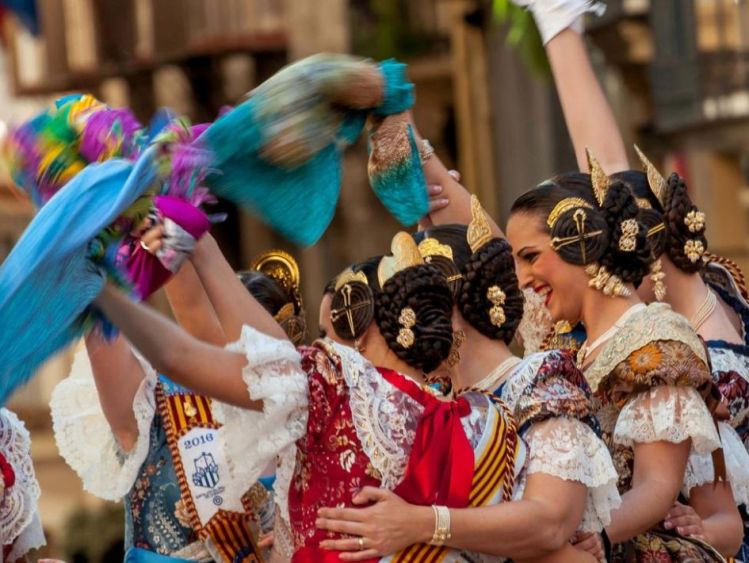
Las fallas de Valencia
Now we are moving to the east coast of Spain, more specifically we are moving to Valencia.
During the 14 - 19 March the ninots, figures that recreate facts, fictitious or real characters or have a specific message. The ninots are made with easily combustible materials to burn the night of the 19th.
Fire is an essential part of these festivities because it represents purification. During "La cremá", people gather next to a falla to celebrate the incineration of what is left over in society.
The only falla that is saved from incineration is the winner, which is granted a pardon and exhibited in the Fallas Museum of Valencia.
As with many traditions, its origin is not entirely clear, but the best-known version says that it was the custom of the ancient carpenters who, on the eve of St. Joseph's Day (a feast we celebrate on March 19), burned old materials as a way of celebrating the end of winter. Next to the remains of wood, they placed candlesticks that they held on a stick as a lampstand.
Los Sanfermines
Finally, we are going to talk about Las Fiestas de San Fermín, better known as "Los Sanfermines" in Pamplona. It is a very well known popular festival in Spain that starts on July 6th with "El chupinazo", a rocket launched at noon from the balcony of the Town Hall of Pamplona to signal the start of the festivities of San Fermín, followed by the "Pregón”, an opening speech and the famous running of the bulls: a very high speed race of 875 meters accompanied by bulls, an extremely exciting but also dangerous experience.
This celebration which the author Ernest Hemingway experienced and recorded in his books during his stay in Spain, has its origin in three celebrations:
- The events in honor of San Fermín, which have been organized since the 12th century.
- The commercial fairs, which began to be organized in the 14th century.
- And the bullfights, which began to be organized in the 14th century and became a social event that ended up causing the rest of the celebrations to be related and the three of them to become a single event.
This tradition gathers more and more people of different nationalities who come to Spain to celebrate Spanish festivals and live a unique experience in the world.
Which one would you like to experience? Remember that our online Spanish lessons can be fun and will help you to learn not only the language with the best Spanish tutors but also to discover this great culture.
See you soon!